
Radiant barrier in Los Angeles
A hot roof sends its heat down into the attic. A radiant barrier reflects part of it back. We install it where it works and tell you where it does not.
A radiant barrier is a layer of aluminum, set facing an air space, that reflects radiant heat instead of passing it on.
On a sunny afternoon the roof surface gets very hot and radiates that heat down toward the attic floor. The barrier sits in the way. It is not insulation in the usual sense, because it does not slow heat moving through a material. It works on the heat that travels as radiation across the open space under the roof.
We install radiant barriers in houses across Los Angeles and Ventura County, from Tarzana, Calabasas and Thousand Oaks to Pasadena, Santa Monica and the South Bay. For the full list of work, see all our insulation services.
When a radiant barrier is worth asking about
The benefit is in the cooling season, so the signs are about summer heat.
An attic that bakes in summer
A roof in direct sun passes a great deal of heat into the attic, and that is the heat a barrier is placed to reflect.
An air conditioner that runs long hours
In hot weather the cooling load is where a radiant barrier acts, by reducing the heat coming down from the roof.
Ducts running through the attic
How much a barrier helps depends partly on where the ductwork sits, so ducts in the attic are a reason to look at one.
An attic that already has insulation
A barrier is added to insulation, not instead of it. We look at what is in the attic first.
Spring and fall warmth
A barrier can keep attic and ceiling surfaces cooler in mild seasons too, which helps a room's comfort without the air conditioner.
Open rafters or trusses
The barrier is fastened to the framing, so how the roof is built affects the method.
How a radiant barrier works
Aluminum reflects radiant heat well and gives off very little. Put it in an air space between a hot surface and a heat-absorbing one and it blocks a large part of the heat moving across.
The reflective face has to look into an air space. Foil laid flat against something does not reflect, it conducts. A barrier does not need to be airtight, since it works on radiant heat and not on moving air, and small tears have little effect. Attic ventilation from the soffit to the ridge helps it perform.
Where it goes and what it is made of
There are three usual places for a radiant barrier in an attic.
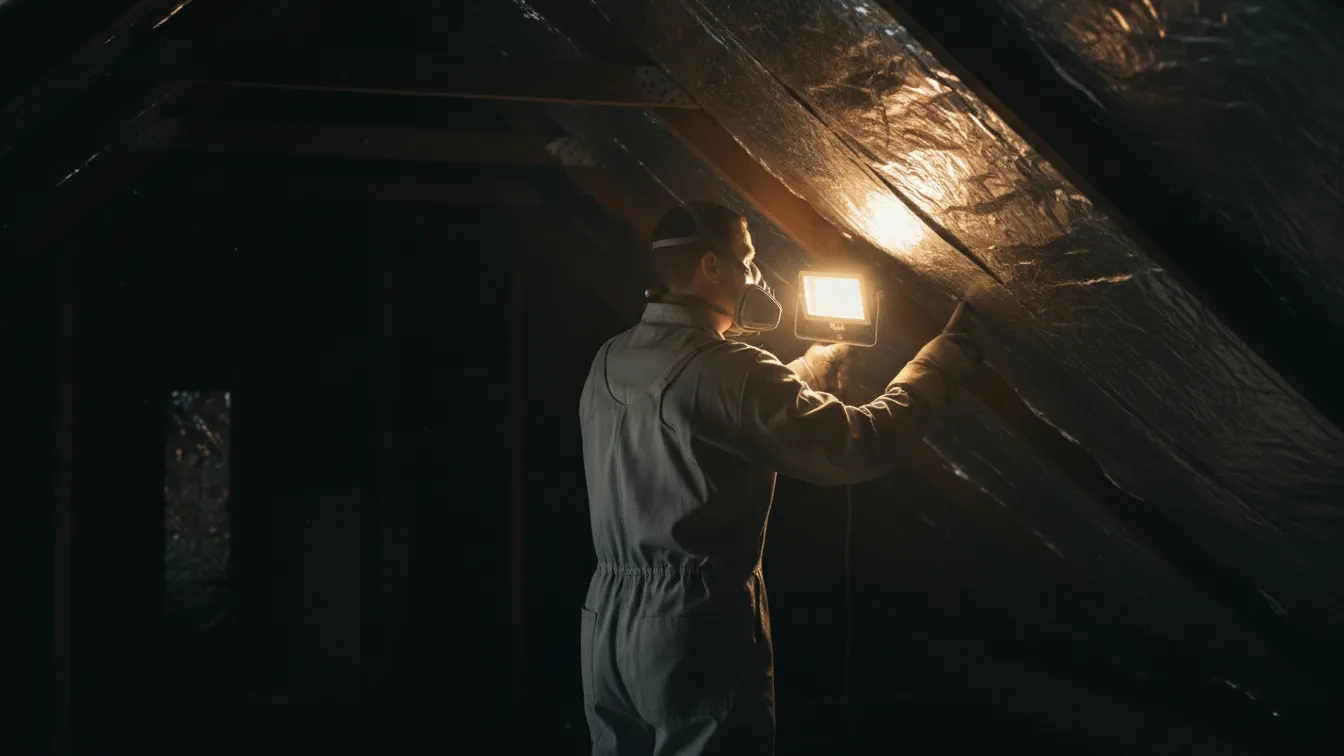
- Under the roof sheathing, on the top side of the trusses. The barrier is fastened under the roof deck, with its reflective face looking down at the attic.
- Under the top chord of the trusses. The same idea, a step lower, with an air space above the foil.
- On top of the attic insulation. This is the weakest spot for sheet foil, because dust settles on the foil and dulls it, and a barrier laid straight on insulation can trap moisture. Loose chip products and multilayer products are the ones that suit this spot.
Single-sided foil goes with its shiny face down, because foil facing up gathers dust. We pick the placement from how your roof and attic are built.
What a radiant barrier does not do
It is not a substitute for insulation. Insulation slows heat conducted through a material. A radiant barrier works on radiant heat. In a house that is cooled in summer they work together.
The benefit also depends on the house. It is greatest in the cooling season, and less in a heating-dominated climate where the heat in the attic is useful. Savings depend on the location of the ducts, the size of the house, the type of installation and the attic ventilation. Dust on the foil, or foil with no air space, reduces what it does.
How it fits with the other services
Attic work often combines these, so we look at the whole attic. Attic insulation is the layer a radiant barrier is added to, and spray foam insulation is a different way to treat the same roof, because foam is insulation and a barrier is a reflective surface. If the old insulation is in the way, see insulation removal.
Radiant barriers are an attic and roof measure, so they do not replace wall insulation or crawl space insulation. We tell you which of these is worth doing for your house, and in what order.
What the visit looks like
You tell us about the attic
How the roof is built, what insulation is up there, where the ducts run and what the house is like in summer.
We go up and look
We check the framing, the ventilation, the wiring and the existing insulation, and decide whether a barrier suits the attic.
We choose the placement
Under the roof deck, under the trusses or over the insulation, depending on what the attic allows.
We install it with care around the wiring
The barrier is fastened to the framing and never through or over electrical wiring. The attic is left clean.
Radiant barrier questions
Do radiant barriers really work?
Yes, for the job they do. A radiant barrier reflects radiant heat from a hot roof and so reduces the heat coming into the attic in summer. How much it helps depends on the house, the ducts, the ventilation and how it is installed.
Is radiant barrier better than insulation?
They do different jobs, so neither is better. Insulation slows heat as it passes through a material, and a radiant barrier reflects radiant heat. A radiant barrier is usually an addition to insulation and not a replacement.
What are the disadvantages of using a radiant barrier?
The foil needs an air space facing it, dust on its surface reduces what it does, and it matters less in a house that is heated more than it is cooled. It is also not insulation, so it cannot stand in for it.
Which is better, radiant barrier or spray foam?
They are not the same kind of product. Spray foam is an insulation, and a radiant barrier is a reflective layer. For some roofs the question is which suits the attic, and we look at the framing and the existing insulation before we recommend either.
Can a radiant barrier go over my existing attic insulation?
Sheet foil is not recommended there, because dust settles on it and moisture can collect beneath it. Loose chip and multilayer products are made for that spot. Fastening foil under the roof deck or the trusses leaves an air space and avoids both problems.
Attic that runs hot in summer? Tell us how the roof is built and where the ducts run, and we will tell you whether a radiant barrier suits it.
Get started
Take the heat off your attic
Call us, or send the form and we will call you back. We work across Los Angeles and Ventura County, and we are licensed and insured.